¿Qué es la detección y respuesta gestionadas (MDR)? Guía completa
Información clave
El MDR reduce el tiempo medio de detección de amenazas de 277 días a unos pocos minutos gracias a la supervisión continua y a la experiencia humana (Informe de IBM sobre el coste de una filtración de datos, 2024).
El MDR se diferencia fundamentalmente del EDR (solo herramienta) y del XDR (plataforma) al ofrecer servicios especializados totalmente gestionados las 24 horas del día, los 7 días de la semana, con capacidades de respuesta completas.
Los requisitos de cumplimiento de la NIS2 están impulsando un aumento del 40 % en la adopción del MDR en Europa, y se están produciendo presiones normativas similares a nivel mundial (Gartner, 2025).
Los equipos de seguridad se enfrentan a una ecuación imposible: defenderse dehackers de seguridad y operadores de ransomware que actúan las 24 horas del día, los 7 días de la semana, al tiempo que se enfrentan a recursos limitados, fatiga por alertas y una persistente escasez de talento. Dado que una filtración de datos cuesta ahora a las organizaciones una media de 4,45 millones de dólares y que los ataques de ransomware aumentarán un 41 % mes a mes a finales de 2025, el enfoque tradicional de confiar únicamente en herramientas de seguridad ha llegado a su punto de ruptura (IBM, 2024; SonicWall, 2025).
La detección y respuesta gestionadas (MDR) es un servicio de seguridad en rápido crecimiento que transforma radicalmente la forma en que las organizaciones abordan la detección y la respuesta ante amenazas. El crecimiento explosivo del mercado de MDR, que se prevé que alcance los 11 800 millones de dólares en 2030 con una tasa de crecimiento anual compuesta del 21,9 %, refleja un cambio fundamental: las organizaciones están pasando de estrategias de seguridad centradas en las herramientas a estrategias centradas en los servicios, al reconocer que la tecnología por sí sola no puede seguir el ritmo de las amenazas modernas (MarketsandMarkets, 2024).
Esta guía explica qué es el MDR, cómo funciona, en qué se diferencia de alternativas como el EDR, el XDR y los MSSP, y cómo seleccionar el enfoque más adecuado para su organización. Tanto si es un CISO que evalúa el MDR por primera vez, un analista de SOC que compara proveedores o un responsable de seguridad que elabora un análisis de viabilidad, esta página aborda los aspectos operativos, técnicos y estratégicos de la detección y respuesta gestionadas.
¿Qué es la detección y respuesta gestionadas (MDR)?
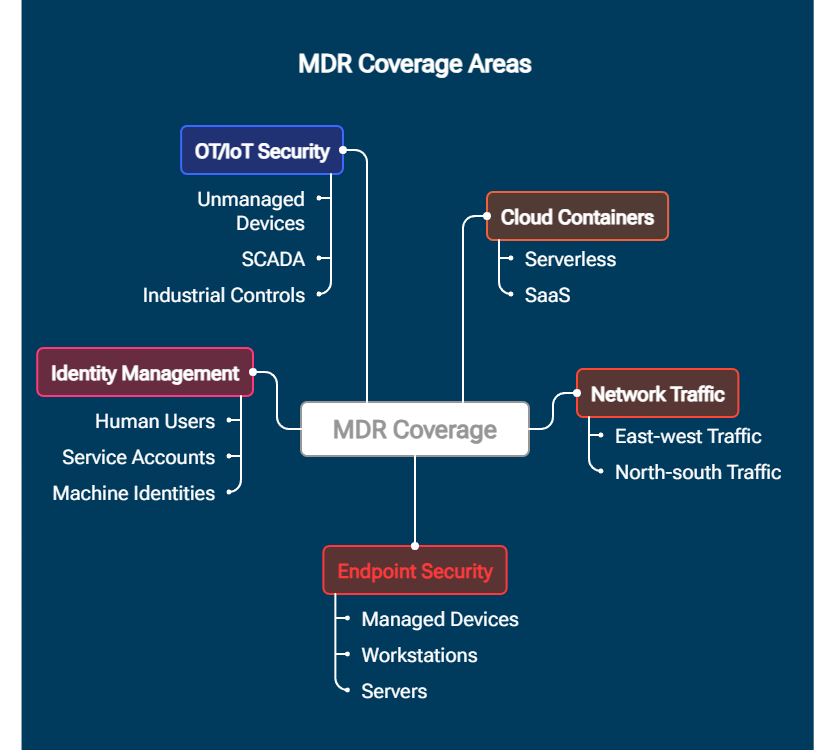
La detección y respuesta gestionadas (MDR) es un servicio de ciberseguridad que combina tecnología de seguridad, inteligencia sobre amenazas, búsqueda de amenazas y experiencia humana para ofrecer supervisión, detección, investigación y respuesta ante amenazas las 24 horas del día, los 7 días de la semana. Los proveedores de MDR ayudan a las organizaciones a identificar y detener los ciberataques mediante el análisis continuo de los datos de seguridad de los terminales, las identidades, las redes, cloud y las aplicaciones SaaS.
¿Por qué las organizaciones necesitan un servicio MDR?
La falta de personal cualificado en ciberseguridad, la rapidez cada vez mayor de los ataques y el aumento de los requisitos de cumplimiento normativo han convertido al MDR en una solución imprescindible para aquellas organizaciones que no pueden mantener internamente operaciones de seguridad las 24 horas del día, los 7 días de la semana. El MDR resuelve limitaciones estructurales que ninguna herramienta o plataforma puede resolver por sí sola.
Los equipos de seguridad están desbordados. El déficit global de personal asciende a 3,5 millones de puestos vacantes en ciberseguridad (ISC2, 2024). Incluso las organizaciones que cuentan con equipos internos de SOC se enfrentan a lagunas de cobertura durante la noche, los fines de semana y los días festivos, precisamente cuando se produce el 88 % de los ataques de ransomware (Informe «Active Adversary» de Sophos, 2025).
Los atacantes actúan con mayor rapidez de la que pueden responder los procesos manuales. El tiempo medio de detección de los delitos cibernéticos se ha reducido a 29 minutos (Informe Global sobre Amenazas de CrowdStrike, 2026). Los ataques basados en inteligencia artificial acortan aún más estos plazos:
La IA generativa acelera el reconocimiento y la ingeniería social a gran escala
Los kits de herramientas automatizados permiten un movimiento lateral más rápido y la escalada de privilegios
Las cargas útiles generadas por IA se adaptan en tiempo real para eludir las defensas estáticas
Los requisitos normativos y de seguros exigen actualmente una cobertura ininterrumpida. El MDR garantiza el funcionamiento continuo, la investigación especializada y los flujos de trabajo documentados que exigen estos marcos normativos:
La NIS2 exige un aviso previo de 24 horas y una notificación de incidentes en un plazo de 72 horas en todas las infraestructuras críticas
Las aseguradoras cibernéticas exigen cada vez más que se documente la supervisión y la respuesta como requisitos previos para la cobertura
Componentes clave del MDR
La detección y respuesta gestionadas (MDR) es un servicio integral de ciberseguridad que combina tecnología de seguridad avanzada con experiencia humana para proporcionar a las organizaciones capacidades de supervisión, detección, investigación y respuesta ante amenazas las 24 horas del día, los 7 días de la semana. A diferencia de las herramientas de seguridad tradicionales, que requieren equipos internos para su funcionamiento e interpretación, MDR ofrece resultados de seguridad como un servicio totalmente gestionado, lo que cambia radicalmente la forma en que las organizaciones se protegen contra las amenazas modernas.
La eficacia de MDR se basa en cinco componentes esenciales que se complementan entre sí para ofrecer una cobertura de seguridad integral.
Priorización y alertas: los análisis avanzados identifican las amenazas más graves entre los miles de incidentes de seguridad que se producen a diario. En lugar de saturar a los equipos con información irrelevante, los servicios MDR centran la atención en las amenazas reales que requieren una respuesta inmediata.
Búsqueda de amenazas: los expertos en seguridad buscan activamente amenazas ocultas que las herramientas automatizadas podrían pasar por alto. Hunters la inteligencia sobre amenazas, el análisis de comportamiento y años de experiencia para identificar a atacantes sofisticados que han eludido las primeras capas de detección. Muchos proveedores de MDR basan sus actividades de búsqueda de amenazas en el MITRE ATT&CK , lo que ayuda a los analistas a identificar las tácticas, técnicas y procedimientos (TTP) de los atacantes a lo largo de todo el ciclo de vida del ataque.
Inteligencia sobre amenazas: Los servicios MDR enriquecen las detecciones con información sobre los adversarios, los indicadores de compromiso (IOC), las técnicas de ataque emergentes y las amenazas específicas del sector. Este contexto ayuda a los analistas a priorizar las investigaciones, acelerar la respuesta e identificar amenazas que podrían eludir los controles de seguridad tradicionales.
Investigación: El análisis forense en profundidad que se lleva a cabo cuando se detectan amenazas permite determinar el alcance, el impacto y la causa raíz. Esta profundidad en la investigación va más allá de la simple validación de alertas, proporcionando a las organizaciones una comprensión exhaustiva de las cadenas de ataque y las tácticas de los adversarios.
Respuesta guiada y corrección: medidas de corrección específicas y prácticas, adaptadas a cada escenario de amenaza. Los servicios de MDR ofrecen orientación específica en lugar de consejos genéricos, y el apoyo a la corrección aborda las vulnerabilidades subyacentes para prevenir futuros ataques.
Integración continua: los componentes de MDR se integran a la perfección en los flujos de trabajo existentes del centro de operaciones de seguridad, mejorando las inversiones actuales en seguridad en lugar de sustituirlas. El resultado es un multiplicador de recursos que mejora notablemente el nivel de seguridad sin necesidad de ampliar considerablemente el equipo interno.
La mayoría de las herramientas de MDR se integran con tecnologías de detección y respuesta en los puntos finales (EDR), gestión de información y eventos de seguridad (SIEM), cloud , protección de identidades y detección de redes para ofrecer una visibilidad completa de toda la superficie de ataque.
¿Cómo funciona el MDR?
Los servicios de MDR siguen un proceso operativo sofisticado, pero ágil, diseñado para maximizar tanto la rapidez como la precisión en la detección y la respuesta ante amenazas. Comprender este flujo de trabajo ayuda a las organizaciones a apreciar el valor que aporta el MDR más allá de las herramientas de seguridad tradicionales y por qué su implementación puede transformar las operaciones de seguridad en cuestión de días, en lugar de meses.
El proceso del flujo de trabajo MDR
El proceso de flujo de trabajo de MDR, tal y como lo definen líderes del sector como Microsoft y CrowdStrike, ofrece un enfoque estructurado para la gestión de amenazas a través de cinco pasos integrados.
El primer paso consiste en la recopilación continua de datos de todo el entorno, con el fin de crear una referencia completa de telemetría de seguridad. Se trata de una recopilación activa e inteligente de datos relevantes para la seguridad, optimizada para la detección de amenazas en los terminales, el tráfico de red, cloud , los sistemas de identidades y las aplicaciones SaaS.
El segundo paso aprovecha la detección automatizada de amenazas para identificar posibles incidentes de seguridad a partir del enorme volumen de eventos diarios. Los motores de correlación avanzados conectan actividades aparentemente inconexas para revelar cadenas de ataques, mientras que los modelos de aprendizaje automático identifican amenazas novedosas sin depender de firmas conocidas.
Muchas organizaciones evalúan conjuntamente las plataformas MDR y las plataformas XDR, ya que ambas ofrecen visibilidad centralizada y capacidades de detección. La diferencia fundamental es que el MDR combina la tecnología con analistas expertos que supervisan, investigan y responden a las amenazas de forma continua.
La intervención humana en la tercera fase aporta un contexto y unos conocimientos especializados fundamentales que la tecnología por sí sola no puede proporcionar. Los analistas de seguridad investigan para determinar si las alertas representan amenazas reales o falsos positivos. Esta validación humana reduce drásticamente la fatiga por alertas, al tiempo que garantiza que las amenazas reales reciban una atención inmediata.
Las recomendaciones de respuesta del paso cuatro proporcionan a las organizaciones medidas claras y priorizadas para hacer frente a las amenazas confirmadas. En lugar de ofrecer consejos genéricos, los servicios MDR proporcionan medidas de corrección específicas adaptadas al entorno de la organización y a la amenaza concreta detectada. El paso cinco va más allá de la respuesta inmediata e incluye apoyo para la corrección, lo que ayuda a las organizaciones a abordar las causas fundamentales y a prevenir ataques similares en el futuro.
Detección en distintos ámbitos
Los servicios MDR modernos implementan capacidades de detección en múltiples ámbitos de seguridad para garantizar una cobertura integral frente a las amenazas.
El análisis del tráfico de red identifica las comunicaciones de mando y control, los intentos de exfiltración de datos y los movimientos laterales entre sistemas. La detección avanzada de red va más allá de la simple comparación de firmas e incluye el análisis del tráfico cifrado, la detección de anomalías en los protocolos y la identificación de amenazas basada en el aprendizaje automático.
Estas capacidades suelen ofrecerse a través de plataformas de detección y respuesta en red (NDR), que analizan el comportamiento de la red para identificar movimientos laterales, comunicaciones de mando y control y la sustracción de datos que las herramientas centradas en los terminales pueden pasar por alto.
La supervisión del comportamiento de los dispositivos finales ofrece una visibilidad detallada de la ejecución de procesos, los cambios en el sistema de archivos, las modificaciones del registro y los ataques basados en la memoria. La supervisión del comportamiento de los dispositivos finales ofrece visibilidad sobre la actividad de los procesos, los cambios en los archivos y las amenazas basadas en la memoria.
La detección moderna va más allá de los antivirus, ya que identifica comportamientos sospechosos incluso sin firmas conocidas. Esto resulta fundamental para ataques como el «SEO poisoning», en los que los resultados de búsqueda manipulados distribuyen malware dominios nuevos o que parecen fiables y que eluden las herramientas basadas en firmas.
La detección de amenazas a la identidad se ha convertido en algo fundamental, ya que los atacantes están pasando de centrarse en la infraestructura a centrarse en las credenciales. Los servicios MDR supervisan los patrones de autenticación, el uso de privilegios y el comportamiento de las cuentas para identificarintentos de apropiación de cuentas y las amenazas internas.
La detección de técnicas como Kerberoasting, el «password spraying» y los ataques de «golden ticket» impide que los atacantes consigan un acceso persistente a través de identidades comprometidas.
La protecciónCloud aborda los retos que plantea la seguridad de cloud dinámicos cloud . Los servicios MDR supervisan los cambios cloud , el uso de las API y los patrones de acceso a los recursos para identificar errores de configuración y ataques activos en contenedores, funciones sin servidor y ofertas de plataforma como servicio.
La IA y la automatización en el MDR moderno
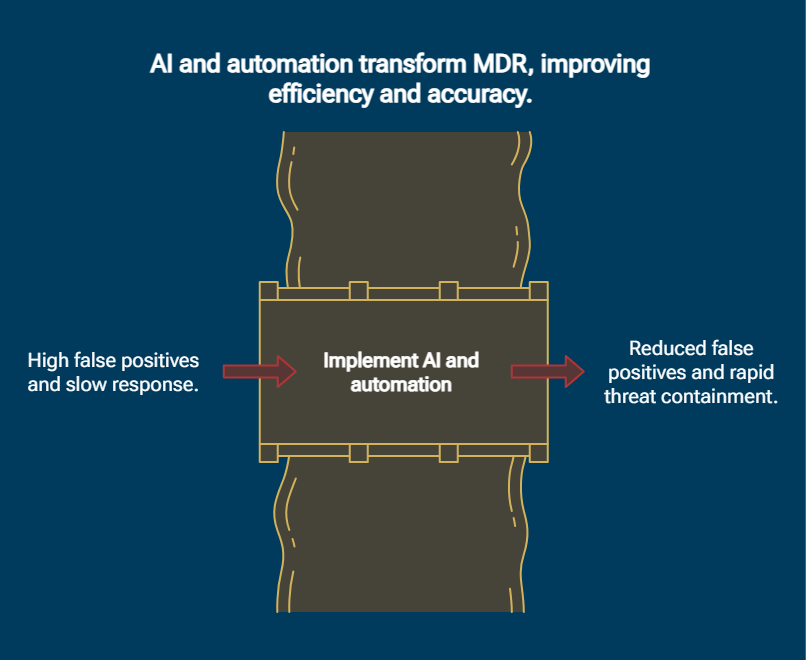
La inteligencia artificial y la automatización han transformado las capacidades del MDR, lo que ha dado lugar a la aparición de servicios de MDR basados en la inteligencia artificial (AI MDR) que combinan el aprendizaje automático, el análisis de comportamientos, la automatización y la experiencia humana para acelerar la detección y la respuesta ante amenazas.
Las plataformas MDR modernas logran una reducción del 85 % en los falsos positivos gracias a modelos de aprendizaje automático entrenados con millones de incidentes de seguridad (Vectra AI, 2025). Estos modelos mejoran continuamente a través de ciclos de retroalimentación, lo que les permite distinguir con mayor precisión las amenazas reales de las anomalías benignas.
Los analistas virtuales basados en IA generativa ahora pueden llevar a cabo investigaciones iniciales, recopilar información contextual y redactar informes de incidentes para su revisión por parte de los humanos. La seguridad predictiva en tiempo real analiza patrones en miles de entornos de clientes y aplica medidas de protección de forma inmediata cuando surge una nueva técnica de ataque contra uno de ellos.
La automatización se extiende también a las medidas de respuesta. Los guiones de respuesta preaprobados permiten contener de inmediato las amenazas confirmadas, por ejemplo, aislando los terminales afectados o desactivando las cuentas comprometidas. Esta capacidad de respuesta autónoma es crucial a la hora de hacer frente al ransomware o a la filtración de datos, situaciones en las que cada segundo cuenta. Sin embargo, la supervisión humana sigue siendo esencial para las decisiones complejas y las situaciones que requieren tener en cuenta el contexto empresarial.
El lanzamiento de Agentic MDR por parte de CrowdStrike en marzo de 2026 marca la siguiente etapa evolutiva: agentes inteligentes que automatizan los flujos de trabajo de seguridad más laboriosos, mientras que los analistas humanos de élite se centran en la interacción con los adversarios y la respuesta estratégica. Las organizaciones que estén evaluando los servicios de MDR deben valorar cómo los proveedores equilibran la velocidad de la automatización con el criterio humano a lo largo de todo el ciclo de vida, desde la detección hasta la respuesta.
MDR contra el ransomware
El ransomware constituye una de las muestras más evidentes del valor operativo del MDR. Los ataques modernos de ransomware no comienzan con el cifrado, sino con el reconocimiento, el movimiento lateral y la escalada de privilegios, procesos que pueden durar semanas o meses, siguiendo cada etapa de lacadena de ataque cibernético antes de que se despliegue la carga útil final. Los servicios MDR detectan estas actividades precursoras mediante el análisis de comportamiento, identificando patrones inusuales de acceso a archivos, ejecuciones anormales de procesos y comunicaciones de red sospechosas que indican la preparación del ransomware.
La supervisión ininterrumpida que ofrece el MDR resulta especialmente importante, dado que el 88 % de los ataques se producen fuera del horario laboral habitual. Los atacantes planifican deliberadamente sus operaciones para que tengan lugar por la noche, los fines de semana y los días festivos, cuando los equipos de seguridad están reducidos al mínimo o ausentes. Los servicios de MDR mantienen una vigilancia constante independientemente de la hora, lo que garantiza que las amenazas se detecten y se contengan antes de que se produzcan daños importantes (Informe Sophos sobre adversarios activos, 2025).
El servicio de MDR de una empresa manufacturera detectó una actividad inusual de PowerShell a las 2 de la madrugada de un sábado. El equipo de MDR investigó de inmediato, identificó una variante del ransomware Qlin que se disponía a cifrar los sistemas y contuvo el ataque antes de que se cifrara ningún dato. Sin la cobertura de MDR las 24 horas del día, los 7 días de la semana, el ataque habría tenido éxito, lo que podría haber supuesto un coste de millones de euros en tiempo de inactividad y recuperación.
MDR en entornos cloud, red y tecnología operativa
El MDR ha evolucionado más allá de la simple protección de los puntos finales para abarcar todo el espectro de los entornos empresariales modernos. Dado que las organizaciones operan en cloud , redes distribuidas y sistemas de tecnología operativa, los servicios de MDR deben ofrecer capacidades de detección y respuesta específicas para cada ámbito que tengan en cuenta las características únicas de cada entorno.
MDR Cloud
Las soluciones MDR Cloud abordan los retos específicos que plantea la protección de las organizaciones cloud. Estos servicios aprovechan herramientas de seguridad y API cloud para ofrecer una visibilidad profunda de cloud , los contenedores y las funciones sin servidor. A diferencia del MDR tradicional, que adapta herramientas locales para cloud , el MDR cloud se ha diseñado desde cero para cloud , supervisando los cambios de configuración, el uso de las API y los patrones de acceso a los recursos con el fin de identificar configuraciones erróneas y ataques activos.
MDR basado en red
El MDR basado en red se centra en analizar los flujos de tráfico, los patrones de comportamiento y las rutas de comunicación en toda la red de la empresa. Al implementar sensores de red en puntos de agregación clave, en lugar de instalar agentes en dispositivos individuales, el MDR basado en red logra una visibilidad completa en cuestión de días, lo que resulta especialmente valioso para las organizaciones con sistemas heredados que no admiten agentes en los puntos finales. Este enfoque detectamovimientos laterales, la actividad de comando y control y la exfiltración de datos que los servicios exclusivos para endpoints pasan por alto, especialmente en el tráfico este-oeste entre sistemas internos.
MDR para la seguridad de OT e IoT
El MDR para infraestructuras críticas da respuesta a las necesidades específicas de las empresas de servicios públicos, las compañías energéticas, los entornos de fabricación y otros proveedores de servicios esenciales. Estos servicios incluyen capacidades de supervisión de la tecnología operativa (OT), conocimiento de los sistemas de control industrial y procedimientos de respuesta que tienen en cuenta los requisitos de seguridad y disponibilidad, distintos de los de los entornos de TI tradicionales. A medida que se multiplican los dispositivos OT e IoT conectados, un MDR especializado para estos entornos garantiza la visibilidad y la protección allí donde no es posible implementar los agentes de punto final tradicionales.
¿En qué se diferencia MDR de EDR?
MDR es un servicio de seguridad totalmente gestionado, mientras queEDR es una herramienta de detección. Las plataformas EDR proporcionan visibilidad sobre las actividades de los puntos finales, detectan comportamientos sospechosos y permiten llevar a cabo acciones de respuesta, pero requieren profesionales de seguridad cualificados para su manejo, para interpretar las alertas y para ejecutar las respuestas.
La implementación de EDR exige a las organizaciones contratar, formar y retener a analistas de seguridad capaces de detectar amenazas, investigar incidentes y coordinar la respuesta. Estos profesionales deben trabajar las 24 horas del día para garantizar una cobertura continua, lo que requiere turnos múltiples y personal de refuerzo. El MDR elimina estas necesidades de personal al ofrecer conocimientos especializados en seguridad como servicio a través de analistas experimentados que han investigado miles de incidentes en entornos muy diversos.
Las consideraciones de coste suelen favorecer el MDR para las organizaciones que no alcanzan la escala empresarial. Crear un centro de operaciones de seguridad disponible las 24 horas del día, los 7 días de la semana, con analistas cualificados puede costar millones al año solo en salarios, sin contar las herramientas, la formación y la infraestructura. Los servicios MDR suelen costar una fracción de esta cantidad, al tiempo que ofrecen capacidades de detección y respuesta superiores gracias a las economías de escala.
¿En qué se diferencia el MDR del XDR y del MXDR?
XDR (detección y respuesta ampliadas) es una plataforma tecnológica que integra capacidades de detección en terminales, redes, cloud y el correo electrónico. Al igual que el EDR, el XDR es, en esencia, una herramienta que requiere operadores cualificados para aportar valor. Los servicios de MDR suelen utilizar plataformas XDR como tecnología subyacente, pero añaden una capa de operaciones gestionadas que transforma las herramientas en resultados.
La convergencia entre MDR y XDR ha dado lugar al MXDR, es decir, la detección y respuesta ampliadas gestionadas. El MXDR ofrece una cobertura tecnológica integral a través de plataformas XDR gestionadas por profesionales cualificados en MDR. Las organizaciones deben evaluar si necesitan la tecnología XDR, el servicio MDR o el enfoque combinado MXDR en función de sus capacidades internas y su nivel de madurez en materia de seguridad.
¿Cuál es la diferencia entre MDR y MSSP?
Los proveedores de servicios de seguridad gestionados (MSSP) ofrecen una gestión más amplia de la seguridad informática, que incluye la gestión de cortafuegos, el análisis de vulnerabilidades y la elaboración de informes de cumplimiento normativo. Aunque los MSSP prestan servicios muy valiosos, suelen centrarse en la prevención y el cumplimiento normativo, más que en la detección activa de amenazas y la respuesta ante ellas. Los servicios MDR se centran específicamente en las fases de detección y respuesta del ciclo de vida de la seguridad, y ofrecen una mayor experiencia y capacidades de búsqueda de amenazas más sofisticadas que las ofertas típicas de los MSSP.
Muchas organizaciones contratan tanto a proveedores de servicios de seguridad gestionados (MSSP) para la gestión de la infraestructura como a proveedores de servicios de detección y respuesta a amenazas (MDR) para la detección y respuesta ante amenazas. La diferencia clave radica en si el servicio incluye la búsqueda activa de amenazas y la respuesta ante incidentes o si se centra principalmente en la supervisión y las alertas.
¿En qué se diferencia el MDR del SIEM?
Las tecnologías SIEM (gestión de información y eventos de seguridad) centralizan la recopilación de datos, ofrecen análisis de registros y facilitan la elaboración de informes de cumplimiento normativo, pero requieren un alto nivel de conocimientos internos para funcionar con eficacia. Los servicios MDR suelen integrarse con las soluciones SIEM ya existentes, aportando el análisis humano ininterrumpido, la búsqueda de amenazas y las capacidades de respuesta activa que las plataformas SIEM requieren pero no incluyen.
Las organizaciones que cuentan con sólidos equipos de seguridad internos pueden beneficiarse de la tecnología SIEM, que pueden gestionar por sí mismas. Aquellas que carecen de experiencia en seguridad suelen obtener mejores resultados con el MDR, que aporta tanto la tecnología como los conocimientos operativos necesarios. Muchas organizaciones implementan ambas soluciones: SIEM para la gestión centralizada de registros y el cumplimiento normativo, y MDR para la detección y respuesta ante amenazas.
La siguiente tabla aclara las diferencias fundamentales entre el MDR y otros enfoques de seguridad relacionados. Cada solución tiene un objetivo distinto, y comprender estas diferencias ayuda a las organizaciones a tomar decisiones de inversión bien fundamentadas.
Solución
Qué es
La experiencia humana
Cobertura 24 horas al día, 7 días a la semana
Respuesta incluida
EDR
Herramienta de detección de puntos finales
No incluido
Requiere equipo interno
Solo capacidades de la herramienta
XDR
Plataforma de detección ampliada
No incluido
Requiere equipo interno
Solo capacidades de la herramienta
MDR
Servicio de detección gestionado
Incluido 24/7
Sí, totalmente gestionado.
Soporte de respuesta completa
MXDR
Servicio XDR gestionado
Incluido 24/7
Sí, totalmente gestionado.
Respuesta ampliada en todos los vectores
MSSP
Gestión amplia de la seguridad
Varía según el servicio.
Normalmente incluido
Normalmente limitado a alertar
SIEM
Plataforma de gestión de registros
No incluido
Requiere equipo interno
Solo alertas y flujo de trabajo
SOC como servicio
Varía mucho
Varía según el proveedor.
Varía según el proveedor.
Varía según el proveedor.
El Reglamento sobre productos sanitarios (MDR) y el cumplimiento normativo
El cumplimiento normativo ha pasado de ser un mero trámite burocrático a convertirse en un requisito operativo continuo, y los servicios de MDR desempeñan un papel cada vez más fundamental a la hora de satisfacer las complejas exigencias normativas. Las organizaciones que combinan el MDR con unaprograma de seguridad operativa (OPSEC) fortalecen ambas posturas: la OPSEC limita la información que los adversarios pueden recopilar antes de un incidente, mientras que el MDR garantiza una rápida detección y contención cuando los adversarios actúan basándose en la información que logran obtener.
La aplicación de la Directiva NIS2 en Europa ha provocado un aumento del 40 % en la adopción del Reglamento MDR, lo que demuestra cómo los requisitos de cumplimiento influyen directamente en la selección de los servicios de seguridad (Gartner, 2025).
La NIS2 exige una alerta temprana de 24 horas en caso de incidentes graves, la notificación de incidentes en un plazo de 72 horas y la presentación de informes finales exhaustivos en el plazo de un mes. Estos plazos tan exigentes son prácticamente imposibles de cumplir sin la supervisión continua y la capacidad de respuesta rápida ante incidentes que ofrece el MDR. La responsabilidad personal de los directivos en virtud de la NIS2, con sanciones que pueden alcanzar los 10 millones de euros o el 2 % de la facturación global, ha convertido al MDR en una prioridad a nivel directivo para las organizaciones afectadas.
El cumplimiento de la HIPAA en el sector sanitario exige una supervisión continua, controles de acceso y una respuesta rápida ante las infracciones. Los servicios de MDR ofrecen registros automatizados e informes listos para auditorías, lo que garantiza que, cuando se produzcan posibles incidentes, la respuesta cumpla con el requisito de notificación de infracciones en un plazo de 60 días establecido por la HIPAA, al tiempo que se conservan las pruebas forenses para su revisión por parte de las autoridades reguladoras.
Los requisitos de notificación de violaciones en un plazo de 72 horas del RGPD y de supervisión continua de la seguridad del PCI DSS generan presiones similares en todos los sectores que manejan datos sensibles. Los servicios MDR garantizan que las organizaciones puedan detectar, investigar y notificar las violaciones dentro de estos plazos tan ajustados, al tiempo que generan la documentación exhaustiva de incidentes que exigen los organismos reguladores.
La siguiente tabla establece una correspondencia entre las capacidades del MDR y los requisitos clave de los marcos normativos, y muestra cómo el MDR respalda directamente las obligaciones reglamentarias en múltiples normas.
Regulación
Requisito
Cómo ayuda el MDR
Sanción por incumplimiento
NIS2
Alerta de incidentes las 24 horas
Supervisión 24/7 y detección rápida
Hasta 10 millones de euros o el 2 % de la facturación global.
HIPAA
Documentación de incidentes de seguridad
Registro y generación de informes automatizados
Entre 50 000 y 2 millones de dólares por infracción
GDPR
Notificación de infracción en 72 horas
Detección e investigación rápidas
Hasta 20 millones de euros o el 4 % de la facturación global.
PCI DSS
Supervisión continua de la seguridad
Supervisión 24/7 e informes mensuales
Entre 5 000 y 100 000 dólares al mes + multas de las entidades emisoras de tarjetas
¿Cómo evaluar los servicios de MDR y elegir el proveedor adecuado?
Con más de 650 proveedores de MDR compitiendo a nivel mundial, elegir al socio adecuado requiere evaluar sus capacidades en cuanto a profundidad de detección, modelo de respuesta, alcance de la cobertura y amplitud de la integración. El rápido crecimiento del mercado de MDR hace que las ofertas varíen considerablemente, desde la supervisión básica de terminales hasta la detección y respuesta multidominio integral.
La profundidad de detección es el criterio de evaluación más importante. No todos los proveedores de MDR desarrollan sus propios modelos de detección; algunos dependen por completo de herramientas de terceros. Los proveedores que desarrollan modelos de detección propios, entrenados con el comportamiento real de los atacantes, ofrecen una mayor precisión en la detección y una cobertura más rápida de las técnicas emergentes. Evalúa si las detecciones se basan en el comportamiento o en firmas, con qué frecuencia se implementan nuevas detecciones y si el proveedor mapea su cobertura con MITRE ATT&CK.
Las capacidades de respuesta varían considerablemente de un proveedor a otro. Algunos solo ofrecen alertas y orientación, dejando la contención en manos del equipo interno del cliente. Otros proporcionan una respuesta totalmente activa, que incluye el aislamiento de hosts, la desactivación de cuentas y el bloqueo de conexiones de red. Evalúa si el modelo de respuesta del proveedor se ajusta a la capacidad de tu equipo interno para aplicar las recomendaciones, en lugar de exigir que sea el proveedor quien actúe directamente.
El alcance de la cobertura determina lo que el servicio MDR puede detectar realmente. Un servicio MDR que solo cubre los puntos finales pasa por alto las amenazas que se propagan a través del tráfico de red, los sistemas de identidades, cloud y los dispositivos no gestionados. Evalúe si el proveedor cubre todos los ámbitos que abarca su entorno, especialmente si utilizacloud híbrida ocloud .
La siguiente lista de verificación ofrece un marco estructurado para evaluar a los proveedores de MDR en función de los criterios que influyen más directamente en los resultados de la detección y la respuesta.
Criterios de evaluación
Qué evaluar
Señales de alerta
Profundidad de detección
Detecciones propias, IA conductual, MITRE ATT&CK , velocidad de detección
Solo firmas, sin alineación con ATT&CK, actualizaciones de detección lentas
Modelo de respuesta
Respuesta proactiva, acuerdos de nivel de servicio (SLA) de contención, guías de actuación automatizadas, asistencia para la corrección de incidencias
Solo alertas, sin capacidad de contención, proceso de escalado poco claro
Ámbito de cobertura
Terminales, redes, cloud, identidad, OT/IoT, SaaS
Solo para terminales, sin visibilidad de la red, cloud limitada cloud
Alcance de la integración
Conectores API, integración con SIEM/SOAR, compatibilidad con herramientas existentes
Integraciones limitadas, dependencia de un único proveedor, sin acceso a la API
Informes y cumplimiento normativo
Informes listos para auditorías, paneles de control ejecutivos, análisis de cumplimiento normativo
No hay informes de cumplimiento, los informes son exclusivamente manuales, no hay métricas
Tiempo medio de respuesta
Acuerdos de nivel de servicio (SLA) con el tiempo medio de reparación (MTTR) documentado, datos históricos de rendimiento, incumplimiento de la garantía
Sin acuerdo de nivel de servicio (SLA), sin métricas publicadas, sin garantía financiera
Información sobre amenazas
Investigación propia, metodología de detección de amenazas, intercambio de información
Sin investigación propia, solo contenidos genéricos, sin programas de búsqueda
¿Cuánto cuesta el MDR?
Los precios de los servicios de gestión de dispositivos móviles (MDR) varían considerablemente en función del proveedor, el alcance de la cobertura y el nivel de servicio, pero la mayoría de los servicios siguen uno de estos tres modelos de tarificación: por dispositivo, por usuario o tarifa plana. Comprender estos modelos ayuda a las organizaciones a elaborar análisis de viabilidad precisos y a comparar las ofertas en términos uniformes.
El modelo de precios por terminal es el más habitual y suele oscilar entre 15 y 50 dólares al mes por terminal, dependiendo del nivel de cobertura, las capacidades de respuesta y la duración del contrato. Una organización con 500 terminales puede esperar unos costes anuales de MDR de entre 90 000 y 300 000 dólares, lo que supone una fracción del coste que supondría crear una capacidad interna equivalente.
La comparación con los costes internos de un SOC pone de manifiesto el valor del MDR. El salario anual de un solo analista de SOC con experiencia oscila entre 90 000 y 130 000 dólares. Para ofrecer una cobertura ininterrumpida se necesitan como mínimo cinco analistas, sin contar aún las herramientas, la formación, la gestión y la infraestructura. El coste medio de una filtración de datos alcanzó los 4,88 millones de dólares en 2024, lo que convierte el coste del MDR en una inversión estratégica para la reducción del riesgo, más que en un gasto (Informe de IBM sobre el coste de una filtración de datos, 2024).
En la siguiente tabla se comparan los tres principales modelos de fijación de precios del MDR y sus características habituales.
Modelo de precios
Rango típico
Ideal para
Consideraciones
Por terminal
Entre 15 y 50 dólares por terminal al mes
Organizaciones con un número definido de dispositivos
El coste varía de forma lineal en función del número de nodos; cloud pueden facturarse por separado
Por usuario
Entre 30 y 80 dólares por usuario al mes
Entornos con un fuerte componente de identidad
Cubre todos los dispositivos por usuario; ideal para entornos BYOD
Tarifa fija
Precios personalizados
Grandes empresas con entornos complejos
Presupuestos predecibles; pueden incluir descuentos por volumen y acuerdos de nivel de servicio (SLA) personalizados
Las garantías en caso de violación de la seguridad se han convertido en un factor diferenciador entre los proveedores de MDR, y los servicios líderes ofrecen una cobertura de entre 1 y 10 millones de dólares. Estas garantías proporcionan protección financiera y demuestran la confianza de los proveedores en sus capacidades de detección y respuesta.
Cómo Vectra AI el MDR
El enfoque Vectra AIrespecto al MDR aprovecha la tecnología Attack Signal Intelligence™ para transformar radicalmente la forma en que las organizaciones detectan y responden a las amenazas. En lugar de saturar a los analistas con alertas, la plataforma identifica y prioriza las señales de ataque reales que se ocultan entre el ruido de la actividad normal de la red. Esta priorización basada en la inteligencia artificial reduce la fatiga por alertas en un 85 %, al tiempo que garantiza que las amenazas críticas reciban atención inmediata.
El punto fuerte exclusivo de la plataforma reside en su capacidad para detectar ataques que eluden los controles de seguridad tradicionales. Mediante el análisis del tráfico de red, el comportamiento de las identidades, cloud y los patrones de uso de SaaS, Vectra AI los atacantes sofisticados que han logrado burlar las defensas perimetrales. La detección integrada en entornos híbridos garantiza una visibilidad completa, independientemente del origen de los ataques o de cómo evolucionen.
Vectra MDR combina esta plataforma de detección avanzada con operaciones de seguridad las 24 horas del día, los 7 días de la semana, a cargo de analistas expertos. El servicio hace hincapié en la rapidez y la precisión de la respuesta, con guiones de respuesta automatizados que contienen las amenazas en cuestión de segundos mientras los expertos humanos investigan las causas fundamentales. Este enfoque híbrido ofrece la rapidez de la automatización junto con la comprensión contextual que solo los seres humanos pueden aportar.
Como líder del Cuadrante Mágico de Gartner en detección y respuesta de redes, y con 39 patentes en inteligencia artificial aplicada a la ciberseguridad, Vectra AI aporta más de una década de inversión en IA y aprendizaje automático a sus servicios de MDR. Más de 2.000 organizaciones confían en la plataforma Vectra AI para proteger sus redes modernas frente a los ataques actuales.
Las estadísticas, los datos comparativos y los datos de mercado a los que se hace referencia a lo largo de esta guía proceden de informes del sector publicados y de estudios contrastados. Entre las fuentes principales se incluyen:
Informe de IBM sobre el coste de una filtración de datos, 2024: valores de referencia del coste de las filtraciones y estadísticas sobre el tiempo de detección
IDC, 2024 — Mejoras en la eficiencia operativa del MDR y en el tiempo medio de respuesta
Informe sobre amenazas globales de CrowdStrike, 2026: el auge de los delitos electrónicos y la evolución de las técnicas de los atacantes
Informe «Active Adversary» de Sophos, 2025: patrones temporales y frecuencia de los ataques de ransomware
Estudio de ISC² sobre el personal dedicado a la ciberseguridad, 2024: estimaciones del déficit de personal a nivel mundial
MarketsandMarkets, 2024 — Previsiones sobre el tamaño del mercado de MDR y tasa de crecimiento anual compuesta
Gartner, 2024 — Repercusiones del cumplimiento de la NIS2 en la adopción de los servicios de gestión de riesgos (MDR) y las tendencias del mercado
SonicWall, 2025 — Estadísticas de crecimiento intermensual del ransomware
Vectra AI, 2025 — Indicadores de referencia sobre la reducción de falsos positivos a partir de los datos de la plataforma
Los datos de mercado y las previsiones de crecimiento corresponden a las cifras más recientes disponibles en el momento de redactar este informe (marzo de 2026). Los ejemplos de incidentes y los casos prácticos se han extraído de testimonios de clientes publicados y de informes de proveedores de MDR. Cuando varias fuentes ofrecen cifras contradictorias, se cita la estimación más conservadora.
Preguntas frecuentes
¿Qué significa MDR?
MDR son las siglas de «detección y respuesta gestionadas». Se trata de un servicio de ciberseguridad que combina tecnología de detección avanzada con la experiencia de expertos para supervisar, detectar, investigar y responder a las amenazas las 24 horas del día, los 7 días de la semana, en nombre de una organización.
¿En qué se diferencia MDR de EDR?
El EDR (detección y respuesta en terminales) es una herramienta de seguridad que supervisa los terminales. El MDR es un servicio totalmente gestionado que suele utilizar tecnología EDR, pero al que se le añade la intervención de expertos las 24 horas del día, los 7 días de la semana, la búsqueda de amenazas, la investigación y una respuesta completa ante incidentes. El EDR requiere personal interno para su funcionamiento; el MDR ofrece esa experiencia como servicio.
¿Cuánto cuesta el MDR?
El precio de los servicios de MDR suele oscilar entre 15 y 50 dólares al mes por terminal, dependiendo del alcance de la cobertura, las capacidades de respuesta y las condiciones del contrato. También hay disponibles modelos por usuario y de tarifa plana. Por lo general, los servicios de MDR resultan considerablemente más económicos que crear una capacidad interna de SOC equivalente que funcione las 24 horas del día, los 7 días de la semana.
¿Cuánto tiempo lleva la implementación de MDR?
La implementación inicial del MDR suele durar entre 72 horas y 10 días en entornos estándar. Las implementaciones empresariales complejas, con reglas de detección personalizadas e integraciones exhaustivas, pueden prolongarse hasta 90 días. Las organizaciones disfrutan de una protección MDR básica desde el primer día de la implementación.
¿Necesito MDR si tengo un SIEM?
Los sistemas SIEM y MDR tienen funciones complementarias. El SIEM centraliza la recopilación de registros, la correlación y la generación de informes de cumplimiento, pero requiere conocimientos especializados internos para funcionar con eficacia. El MDR añade supervisión humana las 24 horas del día, los 7 días de la semana, la detección proactiva de amenazas y la respuesta activa ante incidentes, algo que el SIEM por sí solo no ofrece. La mayoría de las organizaciones se benefician de ambos.
¿Es necesario el MDR para cumplir con la normativa?
Aunque el MDR no es un requisito explícito de ninguna normativa, las capacidades que ofrece —supervisión continua, detección de incidentes, respuesta rápida y generación de informes listos para auditorías— son exigidas por la NIS2, la HIPAA, el RGPD, la norma PCI DSS y el Marco de Seguridad Cibernética del NIST (NIST CSF). El MDR es la forma más eficaz para que la mayoría de las organizaciones cumplan estos requisitos operativos.
¿Cuál es la diferencia entre MDR y MSSP?
Los MSSP ofrecen una gestión integral de la seguridad que incluye la administración de cortafuegos, el análisis de vulnerabilidades y la elaboración de informes de cumplimiento normativo. Los servicios MDR se centran específicamente en la detección y respuesta ante amenazas, con capacidades de investigación más exhaustivas y una búsqueda proactiva de amenazas. Muchas organizaciones recurren a los MSSP para la gestión de la infraestructura y a los servicios MDR para la defensa activa contra amenazas.
¿Qué debo tener en cuenta a la hora de elegir un proveedor de MDR?
Evalúe la profundidad de detección (IA conductual frente a firmas), el modelo de respuesta (solo alertas frente a contención activa), el alcance de la cobertura (terminales, red, cloud, identidades, OT), el grado de integración, MITRE ATT&CK , los acuerdos de nivel de servicio (SLA) documentados en cuanto al tiempo medio de resolución (MTTR) y si el proveedor lleva a cabo investigaciones propias sobre amenazas.
¿Puede MDR sustituir a mi equipo de seguridad interno?
El MDR complementa, en lugar de sustituir, las funciones de seguridad internas. Se encarga de la supervisión, la detección y la respuesta inicial las 24 horas del día, los 7 días de la semana, lo que permite a los equipos internos centrarse en iniciativas estratégicas, el desarrollo de políticas y la mejora de la seguridad de la organización. Muchas organizaciones utilizan el MDR para ampliar las capacidades de los equipos de seguridad de pequeño tamaño.
¿Cuál es la diferencia entre MDR y MXDR?
El MDR suele centrarse en ámbitos de seguridad específicos (a menudo, los puntos finales y la red). El MXDR (detección y respuesta ampliadas gestionadas) ofrece servicios gestionados en todos los vectores de seguridad —puntos finales, red, cloud, identidad y correo electrónico— a través de una plataforma XDR integrada gestionada por el proveedor de MDR.