¿Qué es la OPSEC? Explicación de la seguridad operativa
Información clave
El 13 % de todas las filtraciones de datos están relacionadas actualmente con modelos, aplicaciones o infraestructuras de IA, y el 97 % de estos incidentes carecen de controles de acceso adecuados (Informe de IBM sobre el coste de las filtraciones de datos, 2025)
La «Shadow AI» representa el 20 % de los incidentes de seguridad y aumenta los costes de las filtraciones en una media de 670 000 dólares por encima del nivel de referencia (Informe de IBM sobre el coste de las filtraciones de datos, 2025)
El 63 % de las organizaciones carece de políticas de gobernanza de la IA o aún las está elaborando, al tiempo que implementa activamente capacidades de IA (Informe de IBM sobre el coste de una filtración de datos, 2025)
La norma CMMC 2.0 (que entrará en vigor el 10 de noviembre de 2025) exige la implantación de programas exhaustivos de seguridad operativa (OPSEC) a todos los contratistas federales, lo que implica el cumplimiento de la norma NIST SP 800-171 Rev. 2 (Documentación modelo CMMC, Departamento de Defensa de los Estados Unidos).
La seguridad operativa (OPSEC) es un proceso sistemático de cinco pasos que protege la información confidencial mediante el análisis de las operaciones desde la perspectiva de un adversario. Identifica qué datos requieren protección, evalúa las posibles amenazas y vulnerabilidades, y aplica contramedidas específicas antes de que los adversarios puedan aprovechar la información expuesta.
¿Qué es la OPSEC (seguridad de las operaciones)?
La OPSEC (seguridad operativa) es un proceso sistemático diseñado para identificar, analizar y proteger la información crítica que los adversarios podrían aprovechar para perjudicar las operaciones, el personal o los objetivos estratégicos de una organización. Examina las actividades propias desde la perspectiva de un adversario, analizando las operaciones tal y como lo haría un atacante, con el fin de identificar vulnerabilidades e implementar contramedidas que impidan a los adversarios obtener la información necesaria para planificar y ejecutar ataques.
El proceso se remonta a la guerra de Vietnam, cuando el ejército estadounidense creó el equipo «Purple Dragon» en 1966 para investigar por qué las fuerzas enemigas se anticipaban sistemáticamente a las operaciones estadounidenses. El equipo descubrió que información aparentemente inocua, al sumarse, revelaba patrones operativos que los adversarios aprovechaban sin necesidad de acceder a datos clasificados. Esto dio lugar a la metodología OPSEC de cinco pasos, que sigue siendo la base de las prácticas modernas de seguridad operativa.
La OPSEC moderna abarca la protección de cualquier información que pueda proporcionar a los adversarios ventajas operativas: configuraciones técnicas, procesos empresariales, información sobre el personal y planes estratégicos que, en conjunto, conforman la superficie de ataque de una organización.
Por qué la OPSEC es importante para la seguridad empresarial
El coste de un fallo en la seguridad operativa es cuantificable y va en aumento:
Coste medio global de una filtración de datos: 4,44 millones de dólares (2025); organizaciones estadounidenses: 10,22 millones de dólares por incidente
Las organizaciones que cuentan con programas de seguridad operativa (OPSEC) bien desarrollados registran un 71 % menos de incidentes de seguridad
Las defensas basadas en inteligencia artificial reducen la duración de las brechas de seguridad hasta en 80 días
Phishing el 16 % de todas las filtraciones de datos, con un coste medio de 4,80 millones de dólares por incidente
A diferencia de las medidas de seguridad reactivas, que responden a los ataques en curso, la OPSEC previeneque los hackers y a los autores de amenazas recopilen la información necesaria para lanzar ataques dirigidos. Las organizaciones con programas de OPSEC consolidados informan de un mejor cumplimiento normativo, una reducción de las primas de seguros y una mayor confianza de los clientes, además de una reducción directa de los costes.
La aparición de la IA en la sombra ha dado lugar a un nuevo tipo de vulnerabilidades de seguridad operativa (OPSEC), que se analizan en profundidad en la sección dedicada a los retos de seguridad operativa relacionados con la IA que figura a continuación.
Seguridad operativa en el ámbito empresarial: aunque el concepto de OPSEC tiene su origen en la doctrina militar, la seguridad operativa se ha convertido en una disciplina fundamental para los equipos de seguridad empresarial, ya que abarca la protección de los procesos empresariales, las actividades de fusiones y adquisiciones, las relaciones de la cadena de suministro y cloud frente al reconocimiento hostil.
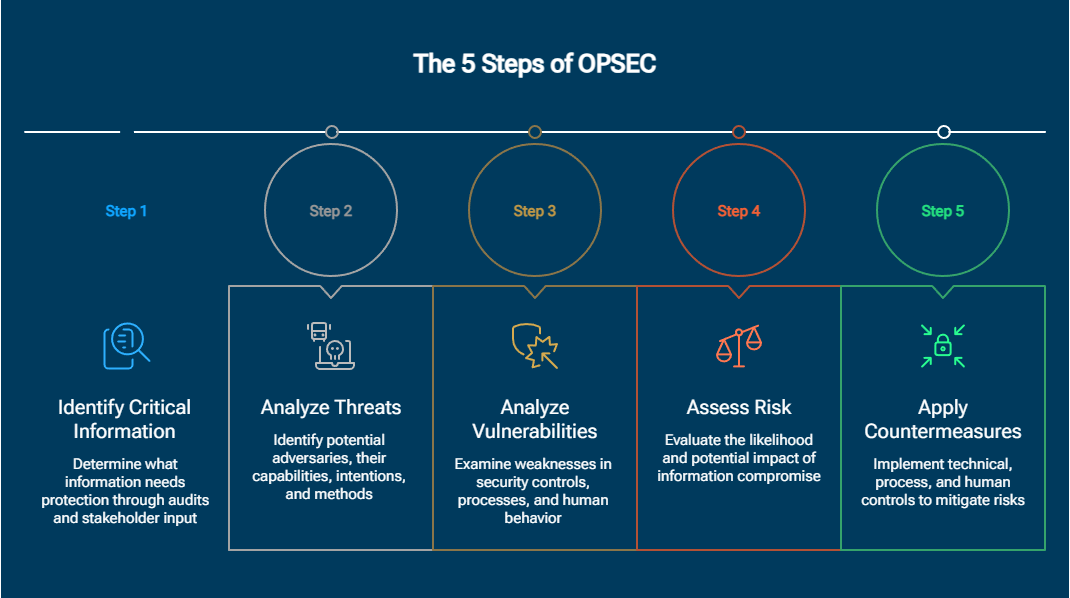
Los 5 pasos de OPSEC
El proceso de OPSEC, compuesto por cinco pasos, ofrece un marco sistemático para proteger la información crítica frente al uso indebido por parte de adversarios. Esta metodología contrastada establece un proceso reproducible que las organizaciones pueden adaptar a sus entornos de amenazas específicos y a sus requisitos operativos.
Paso 1 - Identificar la información crítica
Las organizaciones deben determinar qué información requiere protección mediante la realización de auditorías exhaustivas de los datos, los sistemas y las operaciones. La información crítica va más allá de objetivos evidentes, como la propiedad intelectual y los datos financieros, e incluye planes de fusión, configuraciones de infraestructura, directorios de empleados e iniciativas estratégicas que los adversarios podrían aprovechar.
Para que la identificación sea eficaz, es necesario contar con la colaboración de las partes interesadas de toda la organización, ya que la información crítica varía según el departamento y la función. Los equipos de seguridad deben colaborar con las unidades de negocio para catalogar los activos de información, clasificar los niveles de confidencialidad y comprender su importancia operativa, garantizando así una cobertura exhaustiva y evitando al mismo tiempo una clasificación excesiva que diluya los esfuerzos de protección.
Las empresas modernas también deben tener en cuenta las huellas digitales que revelan información crítica de forma indirecta: puntos finales de API, registros DNS, registros de transparencia de certificados y depósitos cloud que exponen las estructuras organizativas y las tecnologías que facilitan los ataques selectivos.
Paso 2 - Analizar las amenazas
El análisis de amenazas identifica a los posibles adversarios, sus capacidades, sus intenciones y sus métodos de actuación. Comprender cómo avanzan los adversarios a lo largo de la cadena de ataque cibernético, desde la recopilación inicial de información hasta la explotación y la exfiltración, ayuda a los equipos de seguridad a determinar qué activos de información requieren la protección de seguridad operativa (OPSEC) más estricta en cada etapa.
Cada actor malicioso emplea diferentes tácticas, técnicas y procedimientos (TTP). Los actores estatales cuentan con capacidades de amenazas persistentes avanzadas y zero-day , mientras que los ciberdelincuentes recurren a plataformas de ransomware como servicio y a la ingeniería social. Las amenazas de la competencia se centran en el robo de propiedad intelectual y en la recopilación de inteligencia estratégica mediante métodos tanto técnicos como de inteligencia humana.
Paso 3 - Analizar las vulnerabilidades
El análisis de vulnerabilidades examina cómo los adversarios podrían obtener información crítica a través de deficiencias en los controles de seguridad, los procesos o el comportamiento humano, adoptando la perspectiva de un atacante para identificar brechas explotables que las evaluaciones de seguridad tradicionales pasan por alto.
Entre las vulnerabilidades más comunes se encuentran el exceso de información compartida en las redes sociales, los patrones operativos predecibles que revelan horarios y ubicaciones, los canales de comunicación no seguros y los controles de acceso inadecuados. Las relaciones dentro de la cadena de suministro generan una exposición adicional cuando los socios carecen de estándares de seguridad equivalentes. Cloud plantean lagunas en la responsabilidad compartida, riesgos relacionados con la multitenencia y vulnerabilidades en las API que requieren una evaluación explícita de la seguridad operativa (OPSEC), además de los controles tradicionales.
Paso 4 - Evaluar el riesgo
La evaluación de riesgos analiza la probabilidad y el impacto potencial de una filtración de información crítica mediante la combinación de análisis de amenazas y vulnerabilidades, y establece prioridades en las medidas de protección en función de la importancia para el negocio, los requisitos normativos y los recursos disponibles.
Las metodologías cuantitativas asignan valores numéricos a la probabilidad y al impacto, lo que permite tomar decisiones de inversión en medidas de protección basadas en datos. Las evaluaciones cualitativas proporcionan una comprensión contextual de los riesgos que no se prestan a la cuantificación, como el daño a la reputación, la desventaja competitiva o las vulnerabilidades en cadena, en las que una brecha de seguridad da lugar a nuevos ataques.
Paso 5 - Aplicar contramedidas
Las contramedidas eliminan o reducen las vulnerabilidades mediante controles técnicos, mejoras en los procesos y formación en materia de concienciación, logrando un equilibrio entre la seguridad y la eficiencia operativa.
Las medidas técnicas incluyen el cifrado, las restricciones de acceso, la segmentación de la red y la supervisión de comportamientos anómalos. Las medidas de proceso establecen políticas de «necesidad de conocer», procedimientos de gestión de la información y protocolos de respuesta ante incidentes. Las medidas humanas se centran en la formación en materia de concienciación sobre la seguridad y en la creación de culturas sensibilizadas con la seguridad.
Las organizaciones deben poner a prueba las medidas preventivas en entornos controlados, evaluar su eficacia y adaptarlas en función de los resultados obtenidos en la práctica.
OPSEC vs InfoSec: Comprender la diferencia
La seguridad operativa (OPSEC) se centra específicamente en proteger la información operativa crítica frente al uso indebido por parte de adversarios. La seguridad de la información (InfoSec) aplica controles técnicos exhaustivos para proteger todos los sistemas de información y los datos.
La siguiente comparación pone de relieve las diferencias entre estos dos enfoques en cuanto a enfoque, metodología y alcance.
Aspecto
OPSEC
InfoSec
Diferencia clave
Enfoque
Protección de información operativa específica frente a los adversarios
Proteger todos los datos y sistemas de información
OPSEC se centra en la información crítica; InfoSec lo protege todo
Acérquese a
Analiza las operaciones desde la perspectiva del adversario
Implanta controles de seguridad exhaustivos
OPSEC piensa como los atacantes; InfoSec construye defensas
Alcance
Información crítica e indicadores
Toda la infraestructura de información
OPSEC es selectiva; InfoSec es integral
Metodología
Proceso analítico en cinco etapas
Aplicación de controles basados en marcos
OPSEC utiliza análisis basados en amenazas; InfoSec sigue normas
La diferencia fundamental radica en la perspectiva: la OPSEC identifica qué información deben proteger los controles y cómo podrían eludirlos los adversarios; la InfoSec proporciona las capacidades técnicas para protegerla. Las organizaciones logran una seguridad óptima al integrar ambas disciplinas.
¿Qué es la responsabilidad en materia de seguridad operativa (OPSEC)?
El riesgo de seguridad operativa (OPSEC) es la vulnerabilidad de una organización que surge cuando la divulgación incontrolada de información proporciona a los adversarios la información necesaria para planificar y ejecutar ataques selectivos. A diferencia de una vulnerabilidad técnica —una falla en un sistema—, el riesgo de seguridad operativa se acumula a medida que la información aparentemente inofensiva se convierte en información útil para la toma de decisiones.
Cada dato de los que están a disposición del público es, por sí solo, inofensivo. Una oferta de empleo revela el conjunto de tecnologías utilizadas. Un perfil de LinkedIn enumera las responsabilidades de los proyectos. Un comunicado de prensa anuncia una alianza estratégica. Una presentación en una conferencia describe la arquitectura de seguridad interna. Al sumarse, estas revelaciones conforman un panorama de inteligencia detallado que los adversarios utilizan para identificar objetivos de gran valor, trazar las estructuras organizativas y programar los ataques para lograr el máximo impacto.
Los adversarios que llevan a cabo actividades de reconocimiento utilizan la agregación de datos para reconstruir la superficie de ataque de una organización a partir de fuentes públicas sin acceder a ningún sistema protegido, combinando ofertas de empleo, perfiles de LinkedIn, anuncios de socios y registros DNS para obtener un panorama detallado de inteligencia que les permite dirigir ataques selectivos.
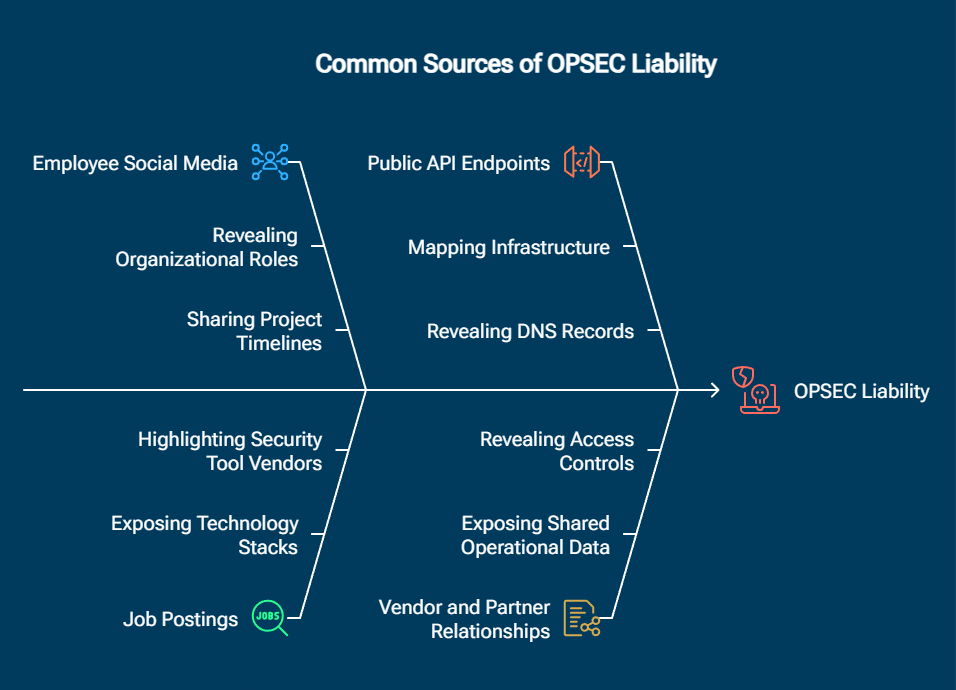
Fuentes habituales de riesgos para la seguridad operativa:
La actividad de los empleados en las redes sociales revela funciones dentro de la organización, ubicaciones y plazos de los proyectos
Ofertas de empleo en las que se revelan las pilas tecnológicas, los proveedores de herramientas de seguridad y las deficiencias operativas
Puntos de conexión de la API pública, registros DNS y registros de transparencia de certificados que describen la infraestructura
Relaciones con proveedores y socios que implican el intercambio de datos operativos y controles de acceso
Presentaciones en conferencias, comunicados de prensa y conferencias sobre resultados que dan pistas sobre iniciativas estratégicas
Para reducir los riesgos relacionados con la seguridad operativa (OPSEC), es necesario realizar auditorías periódicas de inteligencia de fuentes abiertas (OSINT) que analicen qué información pueden recopilar los adversarios a partir de fuentes públicas antes de que se active cualquier alerta de seguridad.
Ejemplos y casos prácticos de OPSEC
Los incidentes recientes ponen de manifiesto cómo las deficiencias en materia de seguridad operativa (OPSEC) en las plataformas de comunicación, cloud y las relaciones con terceros provocan una serie de vulnerabilidades en cadena.
2025 Cronología de incidentes OPSEC
La siguiente cronología recoge los fallos reales de seguridad operativa (OPSEC) ocurridos en 2025, mostrando cómo se desarrolló cada incidente, cuáles fueron sus causas y las lecciones prácticas que las organizaciones pueden aplicar para evitar situaciones similares.
Fecha
Incidente
Causa raíz
Impacto
Lección aprendida
Marzo de 2025
Filtración del Pentágono Signalgate
Grupo de señales mal configurado periodista incluido
Los planes de ataque en Yemen y la identidad de la CIA al descubierto
Verifique la pertenencia al grupo antes de compartir información clasificada
Octubre 11, 2025
Infracción de Qantas/Salesforce
Plataforma de terceros comprometida
Filtración de 5,7 millones de registros de clientes de 39 empresas
Evaluar la seguridad de la cadena de suministro para plataformas compartidas
Octubre 15, 2025
Ataque de Estado-nación a F5 Networks
Exposición del repositorio de código fuente
Configuraciones de clientes comprometidas, Directiva de Emergencia CISA emitida
Proteger los entornos de desarrollo como infraestructuras críticas
Octubre de 2025
Explotación de zero-day Oracle EBS
Vulnerabilidad CVE-2025-61882
Despliegue del ransomware Cl0p en varias organizaciones
Parchee las vulnerabilidades críticas inmediatamente después de su descubrimiento
Mejores prácticas OPSEC
Para aplicar una OPSEC eficaz es necesario abordar simultáneamente los controles técnicos, los procesos organizativos y los factores humanos.
Implemente controles de acceso basados en el principio del mínimo privilegio y en los principios de confianza cero, que verifiquen cada solicitud independientemente de su origen, impidiendoel movimiento lateral en caso de que los adversarios comprometan cuentas individuales. Las revisiones periódicas de los accesos garantizan que los permisos se ajusten a las responsabilidades laborales actuales.
Realice evaluaciones trimestrales de seguridad operativa (OPSEC) siguiendo un proceso de cinco pasos para identificar vulnerabilidades emergentes y verificar la eficacia de las contramedidas. Los ejercicios externos de «equipo rojo» aportan una perspectiva adversaria que los equipos internos no perciben debido a los puntos ciegos de la organización.
La compartimentación limita la exposición de la información al garantizar que cada persona solo acceda a los datos necesarios para el desempeño de sus funciones específicas. Los canales de comunicación exclusivos y los repositorios de documentación de acceso restringido evitan que una sola brecha de seguridad ponga en peligro el conjunto de las operaciones.
Supervisión técnica, sistemas SIEM, análisis del comportamiento de usuarios y entidades (UEBA) ydetección y respuesta en los puntos finales (EDR), deben detectar comportamientos anómalos que indiquen actividades de reconocimiento: patrones de acceso inusuales, intentos de agregación de datos y escalada de privilegios. El EDR amplía los controles de OPSEC al supervisar el comportamiento a nivel de dispositivo en busca de indicios de que los adversarios están actuando sobre la base de la información recopilada, incluso cuando utilizan herramientas legítimas y credenciales válidas.
Lista de comprobación de la aplicación de OPSEC
Establecer políticas de clasificación de la información que definan los niveles de sensibilidad y los requisitos de tratamiento.
Implemente la autenticación multifactorial en todos los sistemas que accedan a información crítica
Implantar herramientas de prevención de pérdida de datos que vigilen las transferencias de información no autorizadas.
Crear programas de formación para empleados que cubran los riesgos de la ingeniería social, la phishing y las redes sociales.
Desarrollar procedimientos de respuesta a incidentes que aborden específicamente los compromisos de la información
Vigilar los foros de la web oscura y los sitios de pasta en busca de información filtrada sobre la organización.
Realizar evaluaciones periódicas de la vulnerabilidad de los activos de cara al público y las API.
Establecer canales de comunicación seguros para debatir operaciones sensibles
Aplicar políticas de gobernanza de la IA con procesos de aprobación claros para el uso de herramientas de IA.
Realice auditorías periódicas para detectar implantaciones de IA en la sombra y el uso no autorizado de servicios de IA.
Establecer controles de acceso para los modelos de IA, las aplicaciones y los datos de formación
Supervisar la seguridad de la cadena de suministro de IA, incluidas las API, los plug-ins y los modelos de terceros.
Retos OPSEC relacionados con la IA
La rápida adopción de la inteligencia artificial ha creado un nuevo frente de vulnerabilidad en materia de seguridad operativa (OPSEC). El Informe sobre fugas de datos de IBM para 2025 identifica la IA y la «IA en la sombra» como riesgos críticos emergentes, ya que el 13 % de todas las fugas de datos afectan actualmente a modelos, aplicaciones o infraestructuras de IA, una categoría que apenas existía en años anteriores.
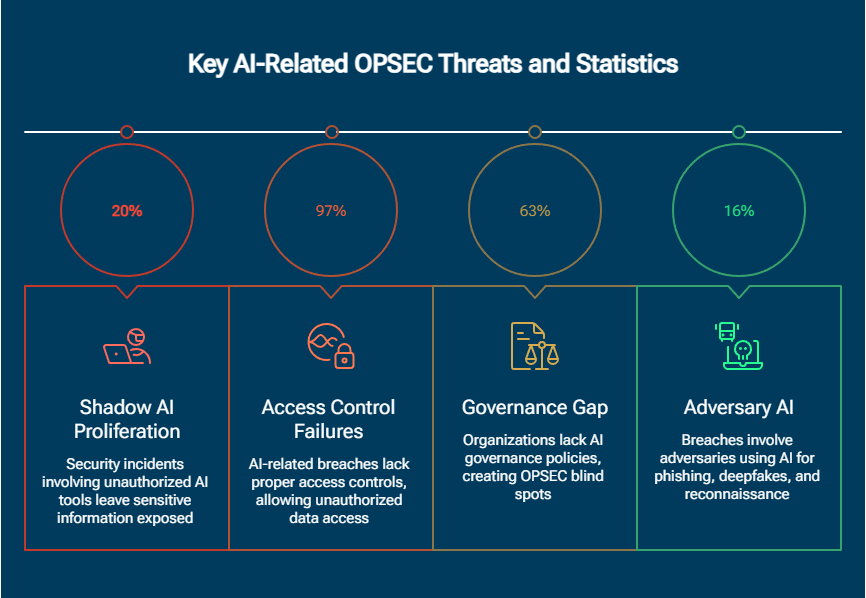
Proliferación de la IA en la sombra
Cuando los empleados utilizan herramientas de IA no autorizadas sin el consentimiento de la empresa, crean canales no supervisados por los que la información confidencial puede salir de los límites de la organización. El 20 % de los incidentes de seguridad están relacionados con la IA en la sombra, lo que aumenta los costes de las filtraciones en una media de 670 000 dólares. Estas implementaciones eluden los controles de seguridad, carecen de supervisión en materia de gobernanza de datos y crean lagunas de auditoría que los adversarios aprovechan; los empleados que suben código propietario, datos de clientes o planes estratégicos a servicios de IA externos exponen inadvertidamente esta información a terceros con niveles de seguridad desconocidos.
Fallos en el control de acceso a la IA
El 97 % de las infracciones relacionadas con la IA carecen de controles de acceso adecuados. Las organizaciones que implementan modelos de IA no aplican medidas básicas de seguridad, requisitos de autenticación, comprobaciones de autorización, validación de entradas ni registros de auditoría, lo que da lugar a situaciones en las que los atacantes pueden consultar los sistemas de IA en busca de información confidencial, manipular los resultados o extraer datos de entrenamiento sin ser detectados. A diferencia de las aplicaciones tradicionales, los modelos de IA pueden memorizar y reproducir inadvertidamente datos de entrenamiento confidenciales, responder a indicaciones maliciosas que eluden las restricciones previstas y servir como puntos de agregación de información procedente de múltiples fuentes.
Brecha en la gobernanza de la IA
El 63 % de las organizaciones carece de políticas de gobernanza de la IA o aún las está elaborando, al tiempo que implementa activamente capacidades de IA, lo que genera puntos ciegos en materia de seguridad operativa (OPSEC) en los que la información crítica circula por los sistemas de IA sin supervisión. Una gobernanza eficaz de la IA requiere políticas que abarquen: el uso aceptable de herramientas de IA autorizadas y no autorizadas; los requisitos de clasificación de datos para las interacciones con la IA; los procesos de aprobación para nuevas implementaciones de IA; los procedimientos de supervisión y auditoría; y los planes de respuesta ante incidentes para casos de vulnerabilidades relacionadas con la IA.
Uso de la IA por los adversarios
El 16 % de las violaciones de seguridad se debieron a que los atacantes utilizaron tecnologías de IA, y el 37 % empleó phishing generadas por IA paraapropiarse de cuentas y el 35 % utilizando deepfakes para suplantar identidades. Los atacantes utilizan la IA para realizar reconocimientos automatizados a partir de fuentes públicas, generar pretextos de ingeniería social y llevar a cabocampañas de envenenamiento de SEO que muestran páginas de descarga maliciosas a través de resultados de búsqueda manipulados, y para adaptar sus estrategias de ataque en tiempo real en función de las respuestas de los defensores.
Cómo Vectra AI los fallos de seguridad operativa relacionados con la IA
Vectra AI la seguridad operativa (OPSEC) mediante Attack Signal Intelligence™, detectando patrones de comportamiento que indican actividades de reconocimiento y recopilación de información por parte de los adversarios antes de que se intensifiquen. Al analizar simultáneamente el tráfico de red, los comportamientos de las identidades y cloud , la plataforma pone de manifiesto fallos de seguridad operativa que se manifiestan como patrones de acceso inusuales, movimientos sospechosos de datos o escaladas de privilegios que preceden a los ataques reales, transformando la seguridad operativa de una simple lista de comprobación preventiva en una capacidad de detección continua que se adapta a medida que evolucionan las técnicas de los adversarios.
Fallos comunes de OPSEC y cómo evitarlos
Los cuatro patrones de fallos de seguridad operativa (OPSEC) más habituales a partir de 2025:
Configuración incorrecta de la plataforma de comunicación: la filtración de Signalgate reveló la identidad de agentes de la CIA debido a la incorporación errónea de un único miembro al grupo
Exposición del entorno de desarrollo: la filtración de F5 Networks puso en peligro los repositorios de código fuente que carecían de controles de seguridad equivalentes a los de producción
Riesgo asociado a plataformas de terceros: la filtración de datos de Qantas y Salesforce dejó al descubierto 5,7 millones de registros de 39 empresas tras el ataque a una única plataforma compartida
Retraso en la aplicación de parches: zero-day de Oracle EBS tuvo éxito porque las organizaciones no aplicaron un parche disponible antes de que los operadores del ransomware Cl0p entraran en acción
El error humano sigue siendo la principal vulnerabilidad en materia de seguridad operativa (OPSEC). La dimensión psicológica de la OPSEC —es decir, la forma en que los adversarios se aprovechan de los patrones de comportamiento humano predecibles— es la vulnerabilidad más difícil de controlar únicamente con medios técnicos. La divulgación excesiva en las redes sociales revela estructuras organizativas, plazos de proyectos y pilas tecnológicas que los adversarios recopilan con fines de reconocimiento. Phishing tienen éxito cuando los empleados desconocen las técnicas de ingeniería social o se sienten presionados a responder rápidamente.
Prevención de fallos OPSEC
Las evaluaciones de seguridad periódicas deben examinar no solo la infraestructura de TI tradicional, sino también las plataformas de colaboración, los entornos de desarrollo y las relaciones con terceros.Los servicios de detección y respuesta gestionados (MDR) amplían la eficacia de la OPSEC al proporcionar una supervisión ininterrumpida que detecta cuándo los adversarios actúan basándose en la información recopilada, incluso durante la noche, los fines de semana y los días festivos, cuando los equipos internos están menos disponibles para responder.
Las organizaciones que deseen desarrollar un programa de seguridad operativa (OPSEC) eficaz deben dar prioridad a los siguientes controles, cada uno de los cuales aborda una deficiencia habitual en la que las actividades de reconocimiento derivan en un compromiso de la seguridad operativa:
Supervisión del comportamiento y detección de anomalías en relación con las amenazas internas
Revisiones del acceso de confianza cero que abarcan a los empleados despedidos y los cambios de puesto
Contratos con proveedores en los que se especifican requisitos de seguridad operativa (OPSEC) y se conceden derechos de auditoría
Auditorías de seguridad de plataformas de colaboración que abarcan las configuraciones de intercambio entre usuarios
Análisis automatizado de los activos expuestos al público antes de cada ciclo de evaluación
Fuentes y metodología
Esta guía se basa en informes de investigación primaria, documentación gubernamental y registros de incidentes verificados, actualizados al primer trimestre de 2026. Todas las estadísticas incluyen una referencia a su fuente primaria. Cuando las fuentes secundarias hacen referencia a investigaciones primarias, se cita directamente la fuente primaria.
Informe de IBM sobre el coste de las filtraciones de datos 2025 (ibm.com/reports/data-breach) — Fuente de datos sobre el coste de las filtraciones, estadísticas de filtraciones relacionadas con la IA, índices de incidentes de IA oculta, datos phishing y tasas de adopción de la IA por parte de los atacantes. IBM lleva a cabo este estudio anualmente en colaboración con el Ponemon Institute entre 604 organizaciones de 17 sectores y 16 países.
Documentación del modelo CMMC — Departamento de Defensa de los Estados Unidos (dodcio.defense.gov/CMMC/Model) — Fuente de información sobre la fecha de entrada en vigor de CMMC 2.0, los requisitos de seguridad operativa (OPSEC) del Nivel 2 y la correspondencia con los controles de la norma NIST SP 800-171 Rev. 2.
Publicación especial 800-53 Rev. 5 del NIST (csrc.nist.gov/publications/detail/sp/800-53/rev-5/final) — Fuente de referencia para la correspondencia entre la familia de controles de seguridad operativa del SC-38 y el marco de controles de OPSEC.
MITRE ATT&CK (attack.mitre.org): fuente de referencias sobre las tácticas, técnicas y procedimientos (TTP) de los adversarios, clasificación de técnicas de reconocimiento (T1595: Escaneo activo; T1598: Phishing información) y clasificación del comportamiento de los actores maliciosos.
Directiva de emergencia 26-01 de la CISA (cisa.gov/emergency-directive-26-01): fuente de referencia para la documentación sobre la violación de seguridad de F5 Networks por parte de un Estado-nación y los requisitos de corrección.
Programa Nacional de OPSEC — Oficina del Director de Inteligencia Nacional de EE. UU. (dni.gov/index.php/ncsc-what-we-do/ncsc-protect-your-secrets/national-opsec-program) — Fuente de la designación del Mes Nacional de Concienciación sobre OPSEC y de las normas del programa gubernamental de OPSEC.
Fallo de seguridad de Qantas/Salesforce (octubre de 2025) — Aviso de seguridad de Salesforce y comunicado oficial de Qantas
Ataque perpetrado por un Estado-nación contra F5 Networks (octubre de 2025) — Directiva de emergencia 26-01 de la CISA y aviso de seguridad de F5
Oracle EBS CVE-2025-61882 (octubre de 2025) — Aviso de Oracle sobre la Actualización de Parches Críticos y catálogo KEV de la CISA
Preguntas frecuentes
¿Qué significa OPSEC?
OPSEC son las siglas de «seguridad operativa», un proceso sistemático diseñado para identificar, analizar y proteger la información crítica que los adversarios podrían aprovechar en su contra. Aunque el término tiene su origen en la inteligencia militar, el concepto de OPSEC se aplica de manera general a cualquier organización que deba proteger información operativa sensible frente al uso indebido por parte de adversarios.
¿Cuál es la primera ley de OPSEC?
La primera regla de la OPSEC es: si no conoces la amenaza, ¿cómo puedes saber qué debes proteger? Este principio establece el análisis de amenazas como la base de todas las actividades de OPSEC. Las organizaciones deben identificar a los adversarios concretos, comprender sus capacidades y objetivos, y evaluar qué información considerarían más valiosa esos adversarios antes de implementar medidas de protección.
¿Qué es la responsabilidad en materia de seguridad operativa (OPSEC)?
El riesgo de seguridad operativa (OPSEC) es la exposición acumulada de una organización que se produce cuando la divulgación incontrolada de información proporciona a los adversarios la información necesaria para planificar y ejecutar ataques selectivos. Se deriva de la acumulación de datos aparentemente inocuos —como ofertas de empleo, perfiles sociales de empleados, anuncios de colaboraciones y datos de infraestructuras públicas— que los adversarios combinan para obtener información útil. Para reducir el riesgo de seguridad operativa es necesario realizar evaluaciones continuas de la exposición a fuentes abiertas, junto con controles técnicos de seguridad.
¿En qué se diferencia OPSEC de InfoSec?
La OPSEC se centra en proteger la información operativa crítica frente al uso malintencionado por parte de adversarios, analizando las operaciones desde la perspectiva de un atacante. La InfoSec implementa controles técnicos exhaustivos para proteger todos los sistemas de información y los datos. La OPSEC identifica qué información requiere protección y cómo podrían obtenerla los adversarios; la InfoSec proporciona los controles técnicos para protegerla.
¿Qué sectores necesitan más OPSEC?
Todas las organizaciones se benefician de la OPSEC, pero entre los sectores de mayor riesgo se encuentran los contratistas de defensa y los organismos gubernamentales que protegen información clasificada, las entidades de servicios financieros que protegen los datos de las transacciones, las organizaciones sanitarias que protegen los datos de los pacientes, las empresas tecnológicas que protegen la propiedad intelectual y los operadores de infraestructuras críticas que protegen sistemas que podrían ser objeto de ataques destinados a provocar interrupciones.
¿Con qué frecuencia deben realizarse las evaluaciones OPSEC?
Las evaluaciones formales de OPSEC deben realizarse al menos una vez al trimestre siguiendo el proceso de cinco pasos. Deben realizarse evaluaciones adicionales tras cambios operativos significativos, la implantación de nuevas tecnologías, reestructuraciones organizativas, fusiones y adquisiciones, o incidentes de seguridad. La supervisión continua complementa las evaluaciones periódicas para mantener un conocimiento en tiempo real de las vulnerabilidades emergentes.
¿Cuáles son los errores OPSEC más comunes?
Entre los errores más comunes en materia de seguridad operativa (OPSEC) se encuentran compartir demasiada información en las redes sociales y profesionales, no evaluar los riesgos asociados a terceros y a la cadena de suministro, controles de acceso inadecuados, una formación insuficiente de los empleados sobre ingeniería social, retrasos en la aplicación de parches para vulnerabilidades conocidas, la falta de supervisión de los activos expuestos al público para detectar fugas de información y la ausencia de políticas de gobernanza de la inteligencia artificial.
¿Se aplica la OPSEC a los trabajadores a distancia?
Sí, los trabajadores remotos necesitan controles específicos de seguridad operativa (OPSEC). Las redes domésticas carecen de los controles de seguridad propios de las empresas, lo que genera vulnerabilidades en las comunicaciones confidenciales y el acceso a los datos. Los trabajadores remotos deben utilizar redes privadas virtuales (VPN) y herramientas de comunicación cifradas, evitar mantener conversaciones confidenciales en lugares públicos y proteger sus redes domésticas con una autenticación sólida. Los requisitos de seguridad operativa (OPSEC) se aplican independientemente del lugar de trabajo.